SOUTH AFRICA
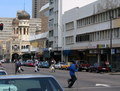
Johannesburg is not what one thinks of when one thinks of Africa. At first glance, it seems well-organized, green, and friendly. BUT... JoBurg has a bad reputation for violent crime as does every large city in South Africa, and this reputation is well deserved. Those nice houses are protected by high walls topped with electric fences, and it is unsafe to walk on many streets, even in daylight. People talk all the time about what is safe and what is not safe. They say, "If you go there with your camera, you won't have your camera for long." Needless to say, I don't have pictures from such areas.
JoBurg reminds me of a Brazilian city, except the crime is worse and there is less racial integration. This makes sense because the brutally racist Apartheid laws were abolished so recently (in 1990). The whites are descendant from the Dutch (Afrikaans) and British colonizers, and they dominate economically. The owners of nearly every business we have dealt with are white, even though the majority are black. Unfortunately, the question of race cannot be ignored. But things would be far worse if Nelson Mandela hadn't promoted unity, forgiveness, and reconciliation. His moral leadership set South Africa on a path to a better future.
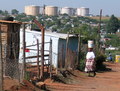
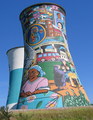
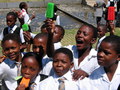
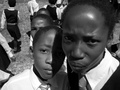
We didn't stay long in JoBurg but we did tour the Soweto area, hit some museums, and met up a friend of a friend, Jethro, who showed us a good time. Then we went into the mountain kingdom of Lesotho via Bloemfontein and Pietermaritzburg. Our plan is to head north as far as Israel, a honeymoon adventure!
 |
 |
 |
 |
 |
 |
March 2005 - Durban and St. Lucia
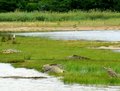
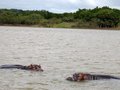
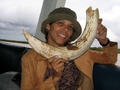
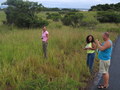
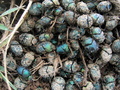
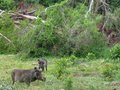
St. Lucia is a peaceful town next to Africa's largest estuary, full of hippos and crocodiles and birds. It is safe to walk at night, except for the hippos. Just last week, a croc ate a snoozing fisherman. We drove with Steve and Regina through the local game park (our first safari). We saw loads of wildlife but alas, no elephants.
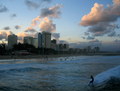
Durban is another one of those unsafe cities. We almost got into trouble by daring to walk at night two blocks from the protected beach-front area. Fortunately, a guy from neighboring Mozambique heard us speaking in Portuguese and came to our rescue. He said that bad people were stalking us, then led us into a bar to have a drink while meanwhile he called us a taxi. The taxi driver showed off his gunshot wounds.
No commentary about South Africa is complete without mentioning HIV / AIDS. It's an enormous problem. Local people constantly bring to my attention the quantity of suffering. This is a sad reality all over Africa. OK, I mentioned it.
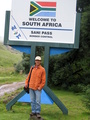
South Africa is a well-developed country, with good roads and infrastructure, and it is expensive. A typical double room in a backpacker's hostel costs about $30 US (no private bath, no free breakfast). One nice thing about travelling here is the door-to-door Baz Bus service. We usually avoid tourist buses, but given the sketchy scene near city bus stations here, this bus service makes travelling safe and easy. Tightly packed mini-buses are the norm in Africa, so we'll enjoy the Baz Bus while we can. And St. Lucia, an oasis of calm.
 |
 |
 |
 |
 |
 |
 |
 |
 |
 |
 |