NEPAL
I bought a one-way ticket to India and so now I have the luxury of living out of a small backpack, exploring the world with no fixed schedule... I walked across the border into Nepal, and at first I did not notice any differences in the culture, but this changed as my bus climbed up into the mighty Himalaya mountains. My colleagues and I hoped to make it to Pokhara before dark but we didn't make it. A military roadblock stopped us at 7pm, enforcing a curfew, so we had to stay the night. Civil war!
Our bus driver explained it like this: the previous king was murdered about 2 years ago, and the new king was behind the plot; the Maoist guerrillas were therefore fighting for a new government, and for justice, and most Nepalese people supported them in principle. The military curfew was for our own protection, he said, but no worries because none of the soldiers target tourists. No worries (for us). The bus driver found us a place to sleep and a meal.
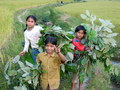
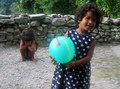
Pokhara is lovely, and I sensed no danger from the war. I met a local family while mountain biking who invited me to join them for the Diwali Festival, sort of like Christmas for Hindus, a family holiday with singing, dancing, candles, and gift giving. Nice!
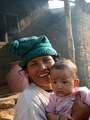
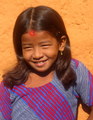
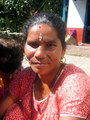
Nepal is so poor (even compared to India) that there is always the money issue. To most Nepalese I am a rich tourist, period, and this usually manifests itself somehow. But despite this reality, just about every local has been genuinely friendly. As with India one must be careful regarding theft, but understanding this and taking the right precautions, it's great to spend time with Nepalese people. They tell me that it's rare to meet a "tourist like me" - or rather, one who takes the time to get to know them. That's one of the great things about travelling alone!
I am planning to trek into a Maoist-rebel-controlled area. A fellow backpacker told me these guys charge "baksheesh" protection money, and tourists who refuse to pay or otherwise do something stupid get beaten up. I intend to pay.
 |
 |
 |
 |
 |
 |
 |
 |
 |
 |
 |
 |
 |
 |
 |
October 2003 - Annapurna Trail
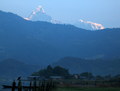
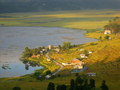
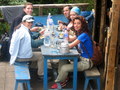
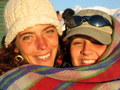
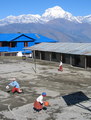
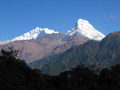
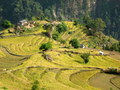
Wonderful scenery... including 8000 meter peaks. Wonderful people... Nepalese and backpackers alike. Even the Maoists were friendly, but on the advice of local people, I did not tell them that I'm American, and I'm sure that was a good idea. Americans pay 5 times more for Maoist "protection" (US $100 instead of $20). The Maoists said they were "fighting against their corrupt king and against American imperialism." I was surely better off being Brazilian. It was easy to get away with this because they did not check passports, and I was with a Spanish-speaking group.
I planned to hike the entire Annapurna Trail loop, but something came up that compelled me to turn around and go back down. That's OK, I had a fabulous time. It's good to have the flexibility to be spontaneous!
Nepal is very poor; there is almost no industry, nor is there much of an upper class. Now is peak tourist season, and there aren't many tourists. It's the war. It's easy to understand why the people who live from tourism are a bit desperate now. This doesn't imply that they aren't nice people, only that they are pushy at times to sell stuff. I highly recommend a trip to Nepal. But as long as the war continues, a good chunk of the country is unsafe. Simply ask locals before going into a remote area. Update: the war is over. Yea!
 |
 |
 |
 |
 |
 |
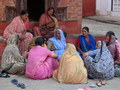
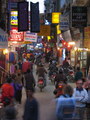
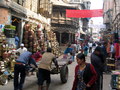
So far I haven't seen most of this city's tourist attractions, but I'll get around to doing all of that. I've been walking randomly, thereby seeing "the real Kathmandu," not just the stuff listed in Lonely Planet. I'm staying in the Thamel district, loaded with cheap hotels, restaurants, shops, and tourists. It's convenient and hassle-free. I was expecting more pollution and crowds, but I have found neither to be excessive, especially compared to Delhi. I am without any travelling companions at the moment, and I'm using that opportunity to get caught up on some reading. I still have books that I brought from Boulder (home) and I want to lighten my pack! But is Boulder my home? Not so much... My backpack is my home, and I love the simplicity of this lifestyle.
 |
 |
 |
 |
 |
 |
 |
 |
 |
November 2003 - Kathmandu, Bhaktapur, Sankhu, Nagarkot
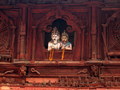
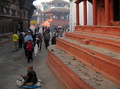
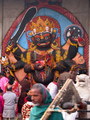
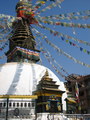
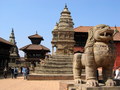
The Kathmandu district of Thamel is a nice place to stay, despite being touristy. That's where I met some other backpackers for a tramp around the valley. We started in Bhaktapur whose Durbar Square has no motor vehicles, no modern buildings, and no cyber-cafes, but does have marvelous ancient temples. In Kathmandu's Durbar Square, the earthquake of 1934 destroyed similar architectural marvels. A local man told me that the earthquake was in 1991. Huh?! This led me to discover that in Nepal the year is 2060! In the villages around the valley however, it seems more like 1700.
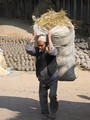
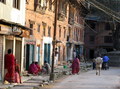
It's great to be where nobody lives in the modern age, where nobody tries to make a dollar from the tourist (because there are so few tourists), where people go about their lives in peace. In such places, I do not miss a comfortable bed, Western food, or flush toilets (and it is possible to get used to using a bucket of water instead of toilet paper to clean one's back side). The village of Sankhu does not have tourist infrastructure and that's part of its charm.
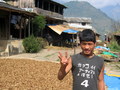
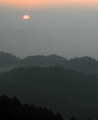
My friends and I joined children to play chungi, kicking bunched-up rubber bands similar to footbag (commonly known by the brand "Hacky Sack"). The kids then guided us along a jungle trail for hours and never asked for anything. After all those hustlers and street sharks in the touristy places, this was quite refreshing. We hiked to a place called Nagarkot to see a sunrise view of Mount Everest. The weather was too hazy to see the peak clearly, but no matter. It was a beautiful sunrise!
I'm incredibly excited about returning to India...
 |
 |
 |
 |
 |
 |
 |
 |
 |
 |
 |
 |
 |
 |
Previous: NW India . . . Next: Central India